Introduction to Auracast Technology

Auracast Broadcast Audio is a new technology based on Bluetooth LE Audio that enables wireless audio transmission to multiple devices at once – and all without the need for pairing.

It allows audio transmitters such as mobile phones, laptops or TVs to broadcast sound to an unlimited number of receivers, including speakers, headphones or hearing aids. This means that with Auracast technology it will be possible to transmit audio from one device to many receivers simultaneously, without standard pairing.
- Connecting an unlimited number of audio devices across different audio brands
- Audio can be played for a large number of listeners
- Devices will be able to broadcast sound in large areas such as airports, stations, theatres, etc.
- The signal range is limited by the physical limits of Bluetooth (usually tens of meters), but larger areas can be covered using multiple transmitters connected to the same audio source.
- There will be three ways to connect:
- Searching for the network just like you search for a Wi-Fi network
- Using a QR code to join the broadcast
- Tapping a button on your audio device
Which hearing aids available in 2025 have built-in Auracast?
- Auracast is a new audio transmission technology that changes the way we perceive sound.
- It enables transmitting audio from one source to a large number of compatible hearing aids and other audio devices nearby.
- For more information about this technology, read our short explanatory article here.
- Auracast is designed for use with hearing aids, cochlear implants, headphones, earbuds and other audio devices equipped with Bluetooth LE Audio and supporting the appropriate codecs – especially LC3.
- Not all hearing aids on the market support Auracast, and some may receive this feature only after a firmware update.
- At the end of this page, you will find a link to an overview of certain devices – such as hearing aids, headphones, mobile phones or tablets – known to support Auracast technology. This list is not exhaustive and some devices or brands may be missing. If you know of others, please let us know at info@unb.cz.
- Note: The technology is evolving quickly, so always consult your audiologist or device manufacturer for the most up-to-date specifications and availability.
Key features of Auracast
| Feature | Benefit |
|---|---|
| Connection without pairing | Simply select a “channel” – similar to Wi-Fi or radio |
| Multiple listeners at once | Many people can listen to the same broadcast |
| Support for hearing aids and implants | The technology is designed for hearing aids and cochlear implants – support depends on the specific model and manufacturer |
| Public audio broadcasting | Ideal for cinemas, airports, schools, public transport, sports events |
| Control via app | Broadcast control can be managed via an app – e.g., adjusting volume, selecting a channel or language (if enabled by the broadcaster) |
Who is Auracast for?
- People with hearing loss who use hearing aids or smartphones
- Seniors who struggle to hear in noisy environments
- Travellers at stations and airports (e.g., gate changes or delay announcements)
- Students at schools and universities – direct transmission of lectures into headphones or hearing aids. If translation is available, it can be transmitted as well.
Examples of use
- Cinema or theatre – clear sound even with poor acoustics
- Airports and train stations – announcements available directly in headphones or hearing aids (if compatible and broadcasting via Auracast)
- Schools and universities – simultaneous translation or lecture audio directly to the ear
- Museums and exhibitions – personal audio commentary, sound-enhanced interpretation
- Stadiums – live match commentary without environmental noise
How does it work technically?
- Bluetooth LE Audio – next-generation low-energy transmission
- LC3 codec – high-quality audio with low power consumption
- Broadcast mode – the device wirelessly transmits audio around it, and compatible receivers can join without pairing – similar to selecting a Wi-Fi network
What do you need to use it?
- Hearing aids or headphones compatible with Bluetooth LE Audio (Auracast-ready)
- Smartphone or device that can search for available broadcasts – usually through an integrated system function or via a manufacturer’s app (e.g., Sennheiser, Listen Technologies, Samsung).
- A place equipped with an Auracast transmitter (e.g., cultural centers, airports, schools)
Where is Auracast already used?
- USA – first pilot installations in airports (e.g., Dallas), schools and museums.
- Europe – early testing in selected cinemas, airports and cultural institutions.
- Asia – test operation at universities and transport hubs in Japan and South Korea.
- Czech Republic and Slovakia Republic – currently in testing phase, for example in newly built or modernized public and cultural facilities.
Auracast and accessibility
Auracast represents a breakthrough technology in the field of inclusive design:
- Improves access to information for deaf and hard-of-hearing people
- Enables a quiet environment – everyone listens individually instead of through public announcements
- Can be combined with visual information – such as subtitles, pictograms, visual alerts or the universal “T” symbol for audio accessibility.
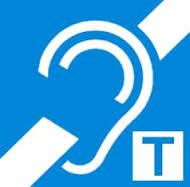
Actual prevalence of hearing loss in the Czech Republic
| Type of impairment | Estimated number of people | Note |
|---|---|---|
| Severe to profound loss | approx. 15,000–20,000 | Including deaf and severely hard-of-hearing individuals from birth |
| Moderate to severe impairment | approx. 300,000–500,000 | e.g., hearing aid users |
| Mild to moderate impairment | up to 1,000,000 or more | Mostly seniors, often without diagnosis |
Actual prevalence of hearing loss in the Slovakia Republic
| Type of impairment | Estimated number of people | Note |
|---|---|---|
| Severe to profound loss | approx. 7,500–10,000 | Including deaf and severely hard-of-hearing individuals from birth |
| Moderate to severe impairment | approx. 150,000–250,000 | e.g., hearing aid users |
| Mild to moderate impairment | up to 500,000 or more | Mostly seniors, often without diagnosis |
Ageing population = more people with hearing loss
- Among people aged 65+, up to 1 in 3 has some degree of hearing loss.
- In the Czech Republic, there are over 2 million seniors – potentially more than 600,000 people with hearing impairment.
- In the Slovakia Republic, there are over 1 million seniors – potentially more than 300,000 people with hearing impairment.
- Other groups include middle-aged adults, children with hearing deficits, and those unaware of their hearing loss.
Why is the figure often stated as “only” 150–500 thousand?
- These are clinically recorded cases or people receiving support (hearing aids, interpreters, educational services).
- Mild forms of hearing loss (e.g., after injury, infection, noise exposure) are often overlooked and unreported.
Up to 1 million people in the Czech Republic and 500,00 people in the Slovakia Republic may have some form of hearing impairment when including:
- Seniors with age-related hearing decline,
- People with mild undiagnosed hearing loss,
- Children and adults with unilateral hearing loss,
- Users of hearing aids and cochlear implants.
Expanding the Auracast Ecosystem
More information about AURACAST
Link here: www.bluetooth.com/auracast
Note: This list is for informational purposes only. Product availability may change. Bluetooth SIG does not sell or provide technical support for the products listed on this page. For more information on specific products, please contact us.